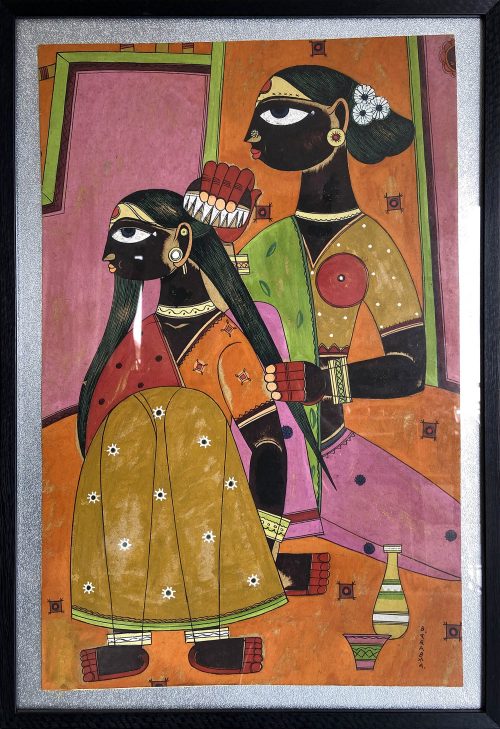
B. Prabha (1933 – 2001)[1] was a prolific Indian artist who worked primarily in oil on canvas. She is best known for her graceful, elongated figures of pensive rural women, each dominated by a single colour. By the time of her death, her work had been shown in over 50 exhibitions, and had found its way into significant art collections, including India’s National Gallery of Modern Art,[2] the TIFR Art Collection and the Air India Art Collection.
Prabha started working at a time when India had few women artists. She was deeply inspired by the work of seminal modernist Amrita Sher-Gil. Much like Sher-Gil, the protagonists of Prabha’s works were usually women. She was moved by the plight of rural women, and over time, they became the main theme of her work. In an interview with Youngbuzz India, she said “I have yet to see one happy woman.”[3] Her paintings also covered a wide range of subjects from landscapes to social issues like droughts, hunger and homelessness.[4]
At her first exhibition, held when she was still a student at art school, 3 of Prabha’s paintings were acquired by Homi J. Bhabha, eminent nuclear scientist and patron of the arts, for the iconic art collection of the Tata Institute of Fundamental Research.[7][8] Prabha’s signature formal style evolved after her marriage to B. Vithal, when she moved from a modern abstraction to more decorative figuration. The artist couple held their first joint exhibition in 1956, the year they were married.
Prabha’s graceful, elongated figures of rural women spotlighted their lives, labour, and the very real contemporary threat of drought, hunger and homelessness. It is significant to note that Prabha, a female artist practicing in an age where women were unapologetically oppressed, used her position and voice as an artist to comment on the same. While her work today might seem like a simple documentation of the figures of rural women, a few decades ago the works were rebellious, and conscious remarks on spirit and the plight of these women.[4] As she famously said, “It is my aim to paint the trauma and tragedy of women.”[9]